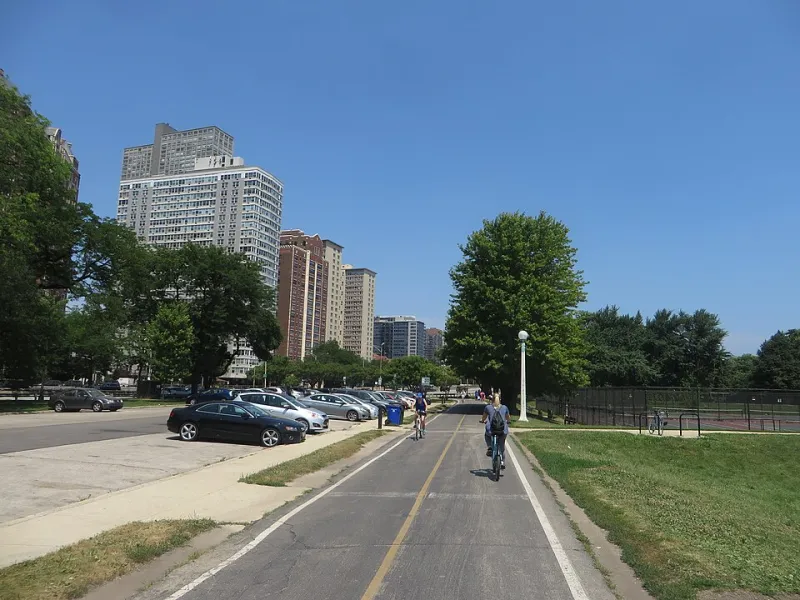
Shorter Drives, Calmer Mornings: How Lakeview's Location Quietly Transforms the Daily Commute

Photo: calm morning lakefront neighborhood street commute professional, via img.freepik.com
For many prospective buyers, the decision to pursue a home in Lakeview begins with the obvious appeal — the water, the views, the particular quality of light that arrives each morning across the shoreline. What tends to surprise people, however, is what they discover once they begin mapping their daily routines against the neighborhood's geography. Lakeview is not merely a scenic address. It is, by a number of practical measures, one of the more strategically positioned residential neighborhoods for working professionals in the region.
The commute — that daily negotiation between home and livelihood — is rarely the first thing buyers discuss with their agents. Yet research consistently identifies commute length and quality as among the most consequential factors in long-term residential satisfaction. When those two variables improve, nearly everything else tends to follow.
A Neighborhood Built Closer to Where Work Happens
Lakeview's position within the broader urban fabric is not accidental. The neighborhood developed in proximity to commercial corridors and downtown employment districts precisely because accessibility was valued by the residents who shaped it. That legacy infrastructure continues to benefit today's homeowners and renters in tangible ways.
For professionals commuting to central business districts, the average drive time from Lakeview's waterfront streets clocks in notably below regional averages. Where suburban counterparts may spend forty-five minutes or more navigating congested arterials, many Lakeview residents report door-to-desk travel times in the fifteen-to-twenty-five minute range. That differential — seemingly modest on any given morning — compounds into meaningful recovered time across a working year.
Consider the arithmetic: a commuter shaving twenty minutes from each leg of a daily round trip reclaims more than eighty hours annually. That figure represents two full workweeks, returned not to an office, but to one's own life.
Traffic Patterns That Work in Your Favor
Beyond raw distance, the character of the commute matters enormously. Lakeview benefits from a routing geometry that keeps many residents off the highest-volume highway segments during peak hours. Rather than funneling into the same chokepoints that afflict commuters arriving from the outer suburbs, Lakeview households often access downtown via secondary corridors and established surface streets that move with relative efficiency during rush periods.
Local traffic analysts have noted that the neighborhood's proximity to the lake itself acts as a natural buffer — the shoreline limits residential density on one side, which reduces the volume of vehicles converging from that direction. The result is a commuting envelope that feels less pressured, even during peak morning windows.
Public transit access further strengthens the picture. Several bus lines and, in some corridors, rail connections serve Lakeview commuters, offering alternatives that suburban residents simply do not have at comparable distances from employment centers. For households willing to leave the car at home, the transit calculus is particularly favorable.
The Science of the Scenic Route
There is a dimension of the Lakeview commute that does not appear in traffic data but is no less real for its intangibility. The route itself — particularly for those traveling along lakefront streets or through the neighborhood's tree-lined residential blocks — carries documented psychological benefits that have become the subject of serious academic inquiry.
Researchers studying commute quality have identified a consistent pattern: the subjective experience of a commute influences workplace performance, interpersonal relationships, and overall life satisfaction in ways that commute duration alone does not capture. A forty-five-minute drive through dense, stop-and-go traffic produces measurably higher cortisol levels and greater emotional exhaustion than a twenty-minute drive through lower-stress environments — even when the latter route is only marginally shorter.
Water proximity amplifies this effect. Studies examining the psychological impact of blue space — a term researchers use to describe environments near lakes, rivers, and coastlines — have found that even brief visual exposure to open water during a commute correlates with reduced anxiety and improved mood upon arrival at a destination. For Lakeview residents whose morning route includes even a passing view of the shoreline, this constitutes a daily, low-effort investment in mental resilience.
"There is something almost meditative about driving past the water before you walk into the office," one longtime Lakeview homeowner described it. "By the time I arrive, I feel like I have already had a moment to myself. That used to seem like a small thing. Now I am convinced it is not small at all."
Commute Quality as a Career Asset
It is worth reframing the commute conversation in terms that resonate with buyers who identify primarily as professionals. The quality of one's daily travel is not a peripheral lifestyle consideration — it is a career variable. Individuals who arrive at work less depleted, less stressed, and with greater cognitive reserves perform differently than those who arrive having already spent an hour in traffic. The research supporting this is robust and has been replicated across industries and demographic groups.
For professionals in demanding fields — finance, healthcare, law, technology, education — the marginal advantage of beginning each workday from a position of relative calm rather than accumulated frustration is not negligible. Over months and years, the cumulative effect on professional output, decision-making quality, and interpersonal effectiveness is substantial.
This reframes the Lakeview waterfront address not merely as a personal indulgence but as a sound professional investment. The home by the water is also the home that sends you to work in better condition.
Rethinking the Tradeoffs
The conventional narrative about waterfront living positions it as a premium choice that requires concessions elsewhere — a longer drive, a less central location, a sacrifice of urban convenience for natural beauty. In Lakeview, that narrative does not hold. The neighborhood offers the scenic and psychological rewards of water-adjacent living without extracting the commuting penalties that buyers are often conditioned to expect.
For buyers currently weighing properties across multiple neighborhoods, it is worth conducting a candid commute audit. Map the actual routes. Account for peak-hour conditions. Factor in the quality of the drive, not just its duration. When those variables are examined with the same rigor applied to square footage or school district ratings, Lakeview's waterfront properties frequently emerge with a competitive advantage that their listing prices do not fully reflect.
A Practical Note for Prospective Residents
For those in active search mode, we recommend scheduling property tours at times that allow you to experience the commute firsthand. Drive the route from a prospective home to your workplace during a typical morning window. Note the traffic volume, the character of the streets, and — importantly — how you feel when you arrive. That experience is data, and it belongs in your decision-making process alongside every other factor you are weighing.
Lakeviews on Reed exists to help buyers and renters find not simply a property, but a home that supports the full architecture of a well-lived life. The commute is part of that architecture. In Lakeview, it is one of the more quietly persuasive arguments for making the water's edge your permanent address.