Where Neighbors Become Friends: The Surprising Social World of Lakeview's Waterfront Streets
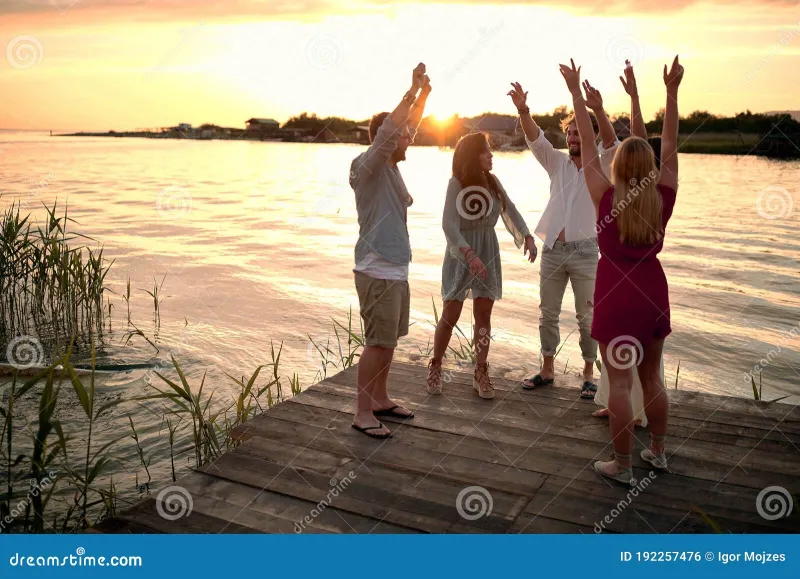
Photo: neighbors socializing on lakefront dock summer evening, via thumbs.dreamstime.com
There is a particular kind of conversation that happens on a dock at dusk. It begins, usually, with nothing more deliberate than two neighbors arriving at the water's edge at the same time — one returning a kayak, another simply watching the evening light shift across the surface. Within minutes, something opens up. The setting seems to invite it. By the time the sky has fully darkened, plans have been made, information has been exchanged, and a friendship has quietly taken root in the way that friendships in most modern neighborhoods almost never do.
This is one of the quieter truths about Lakeview's waterfront communities, and one that rarely appears in a property listing. The views are documented meticulously. The square footage is precise. The amenities are enumerated. But the social dimension — the particular quality of human connection that waterfront proximity seems almost reliably to generate — is harder to quantify and, as a result, often goes unmentioned until a new resident discovers it for themselves.
For prospective renters and buyers considering a move to Lakeview, this dimension is worth understanding before the lease is signed or the offer is accepted. It is, for many current residents, among the most significant reasons they stay.
The Architecture of Accidental Encounter
Urban planners and sociologists have long recognized that the physical design of a neighborhood shapes its social possibilities. Streets that encourage walking, shared spaces that invite lingering, and natural gathering points that bring residents together without requiring formal organization — these are the structural ingredients of community life. Lakeview's waterfront streets possess all of them in unusual concentration.
The shoreline itself functions as a kind of linear commons. Unlike a neighborhood park, which residents must make a specific decision to visit, the waterfront in Lakeview is simply there — present at the end of the block, visible from the living room window, audible in the background of daily life. This persistent proximity means that residents encounter it, and each other, with a regularity that accumulates over time into something meaningful.
Shared docks, community boat launches, and waterfront walking paths all serve as what urban designers sometimes call "third places" — spaces that are neither home nor workplace, where social interaction occurs organically and without agenda. In Lakeview, these spaces are not manufactured amenities added as an afterthought; they are inherent to the neighborhood's geography.
"I had lived in three different Chicago neighborhoods before moving here," one longtime Lakeview renter noted, "and I knew maybe four of my neighbors by name. Within six weeks of moving into my current apartment, I had been invited to two cookouts and a sunset boat ride. The water just changes things."
From Informal Rituals to Organized Community Life
The social life that emerges in Lakeview's waterfront neighborhoods operates on multiple registers simultaneously. At the most informal level, it manifests in the small, recurring rituals that residents develop almost without noticing: the morning wave exchanged between joggers on the lakefront path, the impromptu conversation that begins when two neighbors are both out checking on their boats after a storm, the habit of gathering on a shared dock on Friday evenings that begins with two households and gradually expands to include six.
At a more organized level, Lakeview's waterfront communities support a variety of clubs, associations, and recurring events that provide structure for those who want it. Sailing clubs with active social calendars, neighborhood rowing groups, and informal paddleboard meetups are all part of the fabric of waterfront community life here. Some of these organizations have formal membership structures and seasonal programming; others exist as loosely coordinated group chats that spring into action when the weather cooperates.
Seasonal events add additional texture to the social calendar. Summer brings the informal flotillas and dock parties that are a hallmark of warm-weather life on the water. Fall ushers in a different kind of gathering — bonfires along the shoreline, neighborhood walks to observe the changing colors reflected in the lake, and the particular camaraderie that comes from collectively preparing for the colder months ahead. Even winter, which might seem to contract social life, generates its own traditions among waterfront residents: ice fishing groups, early morning walks along the frozen shoreline, and the neighborly exchanges that accompany the shared work of winterizing docks and boats.
The Role of Proximity in Building Deeper Connections
What distinguishes the community dynamics of Lakeview's waterfront neighborhoods from those of more typical residential areas is not merely the frequency of social interaction but its quality. Researchers who study neighborhood social capital consistently find that the depth of community connection — as distinct from its surface-level pleasantness — depends heavily on whether residents have repeated, low-stakes opportunities to encounter one another over time.
Waterfront living creates precisely this condition. Because the shoreline is a shared resource that all residents use in their own ways and on their own schedules, the encounters it generates are genuinely varied. You meet your neighbors not only at organized events — where social dynamics can feel slightly performative — but in the unguarded moments: early on a Tuesday morning when neither of you planned on running into anyone, or late on a Wednesday evening when the day has wound down and conversation comes easily.
"There is a kind of trust that builds when you see someone repeatedly in ordinary moments," observed a resident who has lived in a Lakeview waterfront building for several years. "You know their routines. You know when something is off. That's not something you manufacture — it just happens when you share a place that you all genuinely love."
This depth of connection has practical dimensions as well. Waterfront neighbors in Lakeview frequently describe robust informal networks for sharing local knowledge — which contractors are reliable, where to find parking during summer weekends, which stretches of the shoreline offer the best conditions for specific activities. These networks, maintained through casual conversation rather than formal organization, constitute a genuine resource for anyone new to the neighborhood.
What This Means for Renters Considering Lakeview
For renters in particular, the social dimension of waterfront living in Lakeview carries specific relevance. Renters are sometimes assumed to be less invested in neighborhood community than homeowners — a perception that the reality of Lakeview's waterfront buildings consistently contradicts. Many of the neighborhood's most socially active residents are long-term renters who have built deep roots precisely because the environment makes community connection so accessible.
When evaluating a Lakeview rental property, it is worth considering not only the unit's interior features and the building's amenities but its relationship to the shared waterfront spaces that make community life here so distinctive. A building with direct shoreline access, a shared dock, or proximity to the neighborhood's walking paths will offer more natural entry points into the social fabric of the area than one that is physically removed from the water's edge.
Ask the property manager about the building's community culture. Inquire whether there are organized resident events or shared spaces where neighbors gather. These questions may feel secondary to the practical concerns of square footage and monthly rent, but for many Lakeview residents, they ultimately prove to be among the most consequential.
The water, after all, is what brings people to Lakeview. But it is the community that keeps them here.